
Image Models
SquadOS generates images via OpenRouter using several models. The cost appears in credits consumed from the organization’s balance. This page lists the estimated cost per image at 1K resolution (about 1 megapixel).
Where to see available models
Section titled “Where to see available models”Models available to the organization live under Settings → AI Models. The same table shows text and image models — image models have a frame icon in the capabilities column.
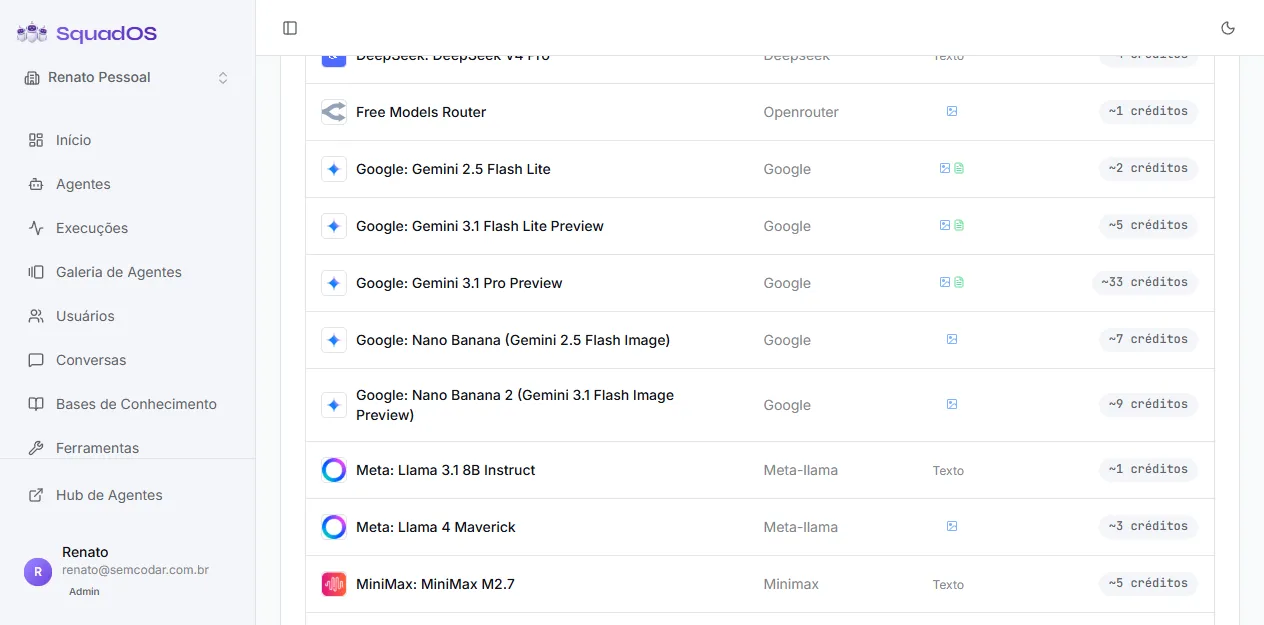
The choice of which image model each agent uses is made when you enable the Generate Image tool in the agent’s Tools tab — see Generate Image.
How cost becomes credits
Section titled “How cost becomes credits”The formula SquadOS uses to convert USD cost to credits is:
credits = (usd_cost * 2000) + 1The result is rounded up with 2 decimal places. The +1 covers operational overhead. When the organization uses its own OpenRouter key (BYOK), the cost is fixed at 1 credit per image.
Estimated cost per image (1K)
Section titled “Estimated cost per image (1K)”Table sorted cheapest to most expensive, considering output close to 1 megapixel (~1290 output tokens on token-based models):
| Model | Credits per image |
|---|---|
| OpenAI: GPT-5 Image Mini | ~6 |
| Google: Nano Banana 2 (Gemini 3.1 Flash Image Preview) | ~9 |
| OpenAI: GPT-5 Image | ~27 |
| Black Forest Labs: FLUX.2 Klein 4B | 29 |
| Google: Nano Banana Pro (Gemini 3 Pro Image Preview) | ~32 |
| OpenAI: GPT-5.4 Image 2 | ~40 |
| Sourceful: Riverflow V2 Fast | 41 |
| Black Forest Labs: FLUX.2 Pro | 61 |
| ByteDance Seed: Seedream 4.5 | 81 |
| Black Forest Labs: FLUX.2 Flex | 121 |
| Black Forest Labs: FLUX.2 Max | 141 |
| Sourceful: Riverflow V2 Pro | 301 |
Values marked with ~ are for token-based models (OpenAI and Google), whose real cost varies with the amount of output tokens emitted by the image. The estimate uses ~1290 tokens per 1024x1024 image (a documented Gemini Image figure), but the GPT-5 family can vary up to ±30% depending on prompt and scene complexity.
Billing types
Section titled “Billing types”Image models bill in three different ways, which affects how cost scales:
- Per image (fixed price): the value per image is the same regardless of size. Ex.: Seedream 4.5, Riverflow V2 Fast and Pro.
- Per megapixel: the value per image grows with resolution. FLUX.2 models (Klein 4B, Pro, Flex, Max) fall here. Images at 2K or 4K cost more than 1K.
- Per token: OpenAI and Google models bill by output tokens. Cost varies with image complexity.
When to use each tier
Section titled “When to use each tier”- Up to 30 credits (GPT-5 Image Mini, Nano Banana 2, GPT-5 Image, FLUX.2 Klein 4B): tests, high volume, simple generations, drafts.
- 30 to 100 credits (Nano Banana Pro, GPT-5.4 Image 2, Riverflow V2 Fast, FLUX.2 Pro, Seedream 4.5): general use with good quality, quick marketing pieces, social content.
- Over 100 credits (FLUX.2 Flex, FLUX.2 Max, Riverflow V2 Pro): final production, materials with high visual demand or model-specific styles.
Best practices
Section titled “Best practices”- Start with cheap models while validating prompt and style.
- Only step up to premium models when quality makes a real difference for the use case.
- Higher resolutions (2K, 4K) multiply cost on per-megapixel models — use 1K as default when possible.
- Track consumption under Settings → Subscription after publishing agents that generate images.
- The values above are estimates at 1K. Real cost can vary with the model, chosen resolution, and prompt complexity.
- OpenRouter prices may change. SquadOS updates the model table via automatic sync, and the credit calculation always uses the current price at the time of generation.